
Imagine being forced to do something that’s known to be seriously bad for your health—something that’s scientifically proven to take years off your life. Something like smoking.
If you were forced to adopt a horrible habit to keep your job or attend school, there’d be outrage, right? Petitions would be started. Politicians would be lobbied. Protests would be organised. No way would you or your kids do it!
And, yet that’s exactly what’s happening every time excessive sitting is actively encouraged—as it is in schools and companies all over the world right now.
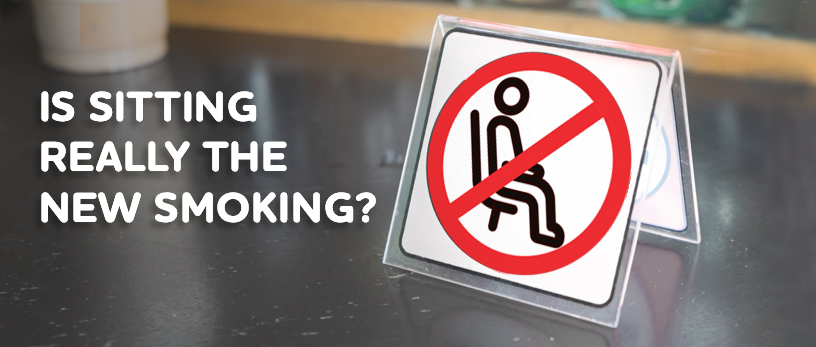
In recent years there has been mounting media coverage of how sitting is hazardous to your health, prompting the slogan: “sitting is the new smoking.” While it makes for a great headline, it’s not entirely true.
Let’s be clear; sitting is not as bad for you as smoking but sitting is bad for you as it significantly increases your risk for serious diseases like cardiovascular disease, obesity, certain cancers, and even premature death.
This isn’t exactly news. The US Surgeon General first reported this link in 1996. And yet, according to the WHO, there has been no improvement in global levels of physical activity since 2001!
That fact alone may be what prompts extreme statements like, “sitting is the new smoking” and “sitting is bad for you”, but big claims like that can sometimes have the opposite effect. They are just too easy to dismiss, especially if the implied solution is to stop sitting. I mean, how realistic is that?
Of course, these analogies do serve a purpose. While sitting may not be as bad as smoking, taking the phrase to its logical conclusions CAN help us find solutions.
If sitting is bad for you and like “the new smoking”, we need to start thinking of the chair as a cigarette. But unlike smoking, the focus should be on reducing our exposure instead of trying to eliminate it.
Maybe you think that’s ridiculous. Five years ago, I would have thought the same thing! That was before I heard my doctor say, “you’re going to need a neck fusion operation.”
I remember feeling confused. Lightheaded. Terrified. I even had a hard time finding my way out of the building as I was in such a state of shock! Looking back, it was the turning point that dramatically changed my work and my life; I just didn’t know it at the time.
Before getting my neck fusion diagnosis, I used to have a ‘proper job as a marketing manager. I spent long hours at my desk and loved my work, but my body did not. And it all started to go wrong in my 20s and 30s with back pain, carpal tunnel, and knee issues.
Eventually, I quit my marketing job to become a Pilates teacher. I continued to “exercise” way more than the WHO guidelines. I wasn’t overweight or particularly stressed. And, yet I still found myself needing a neck fusion operation due to chronic pain. Me, the Pilates teacher and personal trainer!!
Sure, I found out the hard way that sitting is bad for you. But it was the impetus that made me realise the good news: not ALL sitting is EQUALLY bad.That means you don’t have to quit your sitting habit completely BUT reducing it is essential for your health.
Even sitting for 4-8 hours a day is now categorised as a medium risk for sitting disease. And sitting for more than 8 hours a day is a high risk. Feeling squirmy in your chair right now? Yep, that was me too.
I squirmed even more when I found out that there was a term for people like me, people who exercised regularly, even every day, even intensely, but were largely sedentary for the rest of the day. I was an “active couch potato.”
Active couch potatoes who exercise an hour a day are only 6% more active than couch potatoes who never exercise because that one hour of exercise is just ONE hour out of a potential 16 hours of movement.
I’m not going to lie; it was another shock and a definite knock to my ego as a Pilates professional! Why hadn’t I been trained in the importance of general movement, which was so fundamental to true health and quality of life?
Armed with this new perspective, I retrained as a Modern Movement Coach and started adding movement, not exercise, into my day, and my body thrived. I still exercised, but I actively looked for movement opportunities throughout the day and embraced them. I also changed my home/work environment to make more movement unavoidable and didn’t rely on pure willpower.
In short: I was sprinkling short bouts of movement throughout my day and becoming genuinely active. The result? I was able to stop all medication, avoid the fusion operation and all the pain/distress associated with it. My consultant called me twice to wonder why I hadn’t scheduled the procedure and was amazed that I no longer had symptoms. So was I!
My message to you now is hopeful, eminently doable, and probably a lot less scary than trying to quit sitting all together! Because I get it; sometimes you have to sit, BUT there are ways to make it less damaging.
Here are the 3 Top Tips I use to minimise (not eliminate!) my exposure to chairs and sitting damage:
- Sit less
Sounds obvious but sitting less just means standing/walking more. It doesn’t have to take up much/any time. You could stand for a part of a zoom call, stand when taking phone calls, stand to do some of your emails, stand to do the ironing instead of using a chair, park further away from your destination and walk the difference, take a standing/walking break every hour. Look at when you sit during the day and see where you could substitute some standing/walking instead. Every. Substitute. Counts.
- Sit Better
Even if you adopt the perfect sitting posture, you will start to slouch on a chair at some stage. To make this less inevitable, you can change the angle of your chair seat so that it’s approximately 10 degrees upward-sloping and no longer a backward-sloping, active slouch device! You can buy a wedge to place on your chair seat. Or experiment with your own by placing a tightly rolled-up towel near the back of your chair seat but not touching the backrest. Add it to all the chairs in your house – dining chair, office chair, piano stool – and the benefit will be spread throughout the day, every day, without you ever having to think about it! No willpower required.
- Sit Differently
When you have to sit, sit differently. For example, on a yoga ball, on a stool without a backrest, on a lower stool/ottoman, or on the floor using cushions/yoga bolsters. Your body thrives on variety, and having the strength and mobility necessary to get down to and up off the floor is a life skill worth developing/maintaining.
I don’t know anyone willing or able to eliminate sitting entirely. That’s fine – you don’t need to! UNLIKE smoking, you can still get huge benefits from just “cutting back.”
As Wayne Dyer said, “Once you change the way you look at things, the things you look at start to change.”
I hope that you never look at a chair the same way again and that schools and companies never look at a chair the same way again either. That way, they’ll be more likely to adopt the three goals of sitting less, sitting differently, sitting better.
And you and your kids won’t be forced to do something terrible for your health—just to attend school or work—ever again.
Did you learn something new? I hope so! For more WHOLE body health tips, you can sign up for my FREE weekly Modern Movement Coaching Newsletter here.